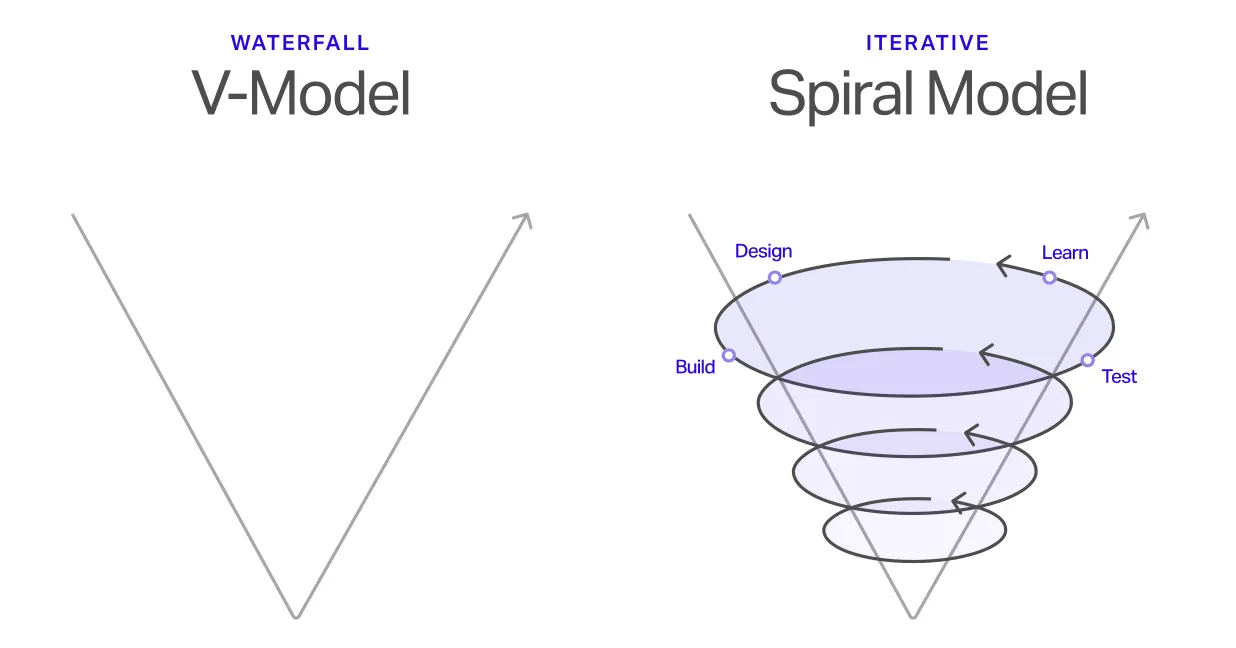
There is a fundamental shift happening in how the world’s most successful deep-tech companies build complex products. The defining trait of this new era isn't a specific software tool or a branded management framework; it is a brutal commitment to adaptability. It is the conscious decision to abandon the question, 'How do we build the perfect system?' and replace it with, 'How fast can we test a flawed one?' We need to stop optimizing for predictability, and start optimizing for velocity.
In classical product engineering, the prevailing wisdom has always been to separate, categorize, and conquer. But as technology cycles shorten and product complexity multiplies, we are finding out the hard way: traditional, domain-heavy systems engineering is buckling under its own weight.
"The most common error of a smart engineer is to optimize a thing that should not exist."
- Elon Musk
Here is why the old model is breaking, and what it actually takes to ship hardware in a modern landscape.
The Trap of the Inverted Pyramid
In a traditional OEM paradigm, product development starts with an inverted pyramid. The business dictates the architecture, draws strict domain boundaries, and cascades requirements downward.
If you are a legacy manufacturer relying entirely on external suppliers, this illusion of control might feel safe. But fast forward three years, and the architecture shatters.
Domains naturally expand. Complexities multiply by 10x. Cross-functional dependencies become critical bottlenecks. Suddenly, incorporating a minor change requires ten different alignment meetings before it ever reaches the engineers actually writing the code or cutting the metal.
Why? Because teams spend so much time defending their own domain boundaries that they forget the actual objective: delivering the product. Organizations obsess over building "scalable" and "reusable" architectures, completely ignoring that at today's pace of innovation, what you are building will likely be obsolete in five years. By optimizing for a pristine architecture, we sacrifice delivery speed—resulting in a product that is perfectly designed for a market that no longer exists.
The Local Minima vs. The Global Minima
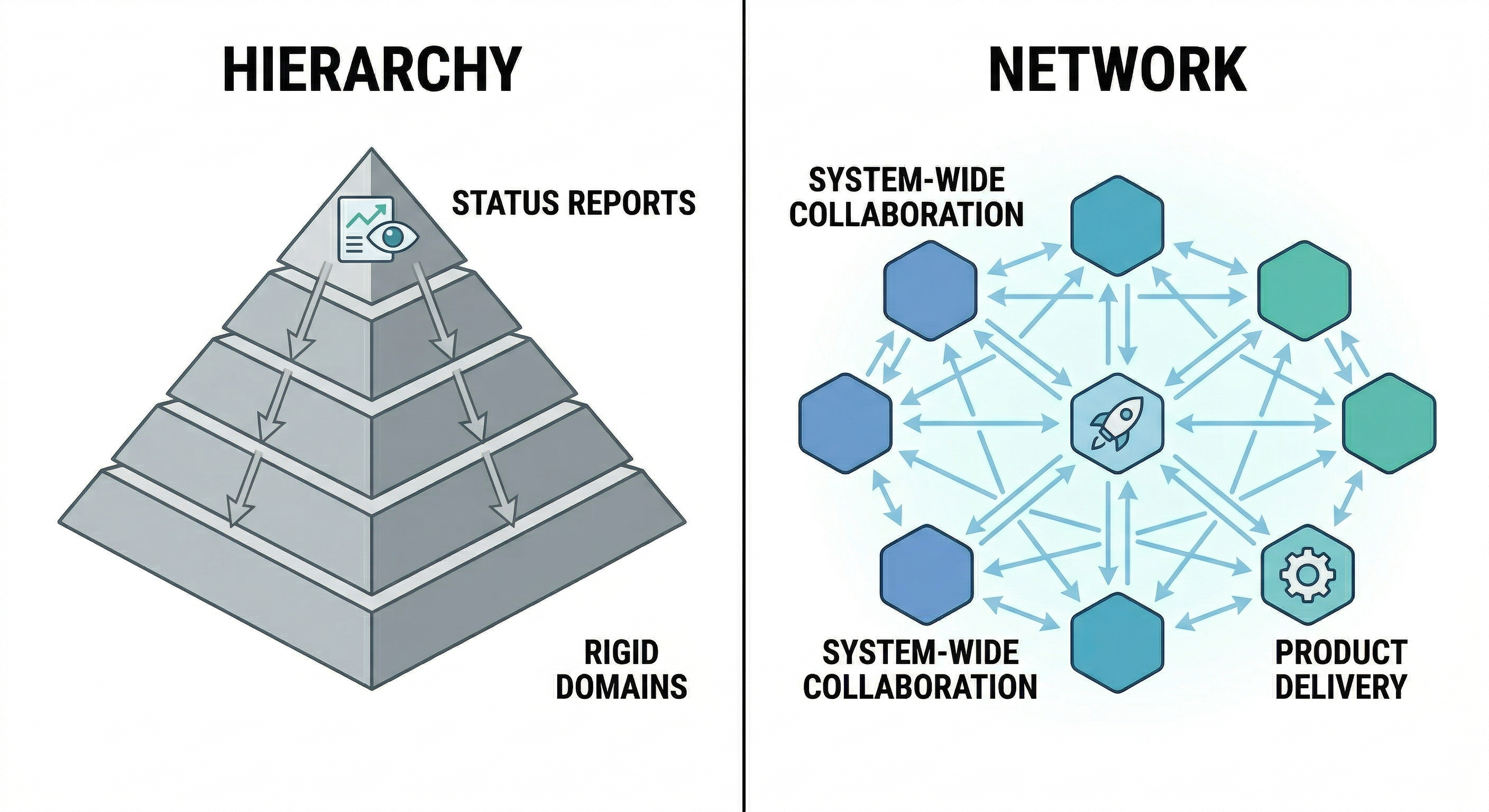
This failure mode is perfectly described by a mathematical analogy: getting trapped in a local minimum.
In optimization algorithms, a system can easily get stuck in a "local minimum"—a valley that looks like the lowest point locally, but entirely misses the "global minimum," which is the absolute best solution overall.
In engineering, this happens when a domain team perfectly optimizes their specific piece of the puzzle at the expense of the overall system. To solve genuinely hard problems, you cannot afford domain purists. Every engineer must be a systems thinker first, and a domain expert second. They must be willing to make painful sacrifices in their own area (like accepting a heavier, uglier component) for the overall survival of the system (like saving months of integration time).
It is incredibly difficult to enforce this. It's much easier to stay in your lane and point to a spec sheet. In heavily siloed organizations, system requirements aren't tools for collaboration; they are armor. Engineers use them to say, "Don’t ask me to think about the wider system, I met my target." This creates functional silos, breeds hostility, and leads to brilliant minds spending thousands of hours optimizing a thing that simply should not exist in the first place.
The Antidote: Flat Accountability
So, how do the companies actually shipping complex systems bypass this? They don't adopt another software tool. They change the physics of their engineering culture.
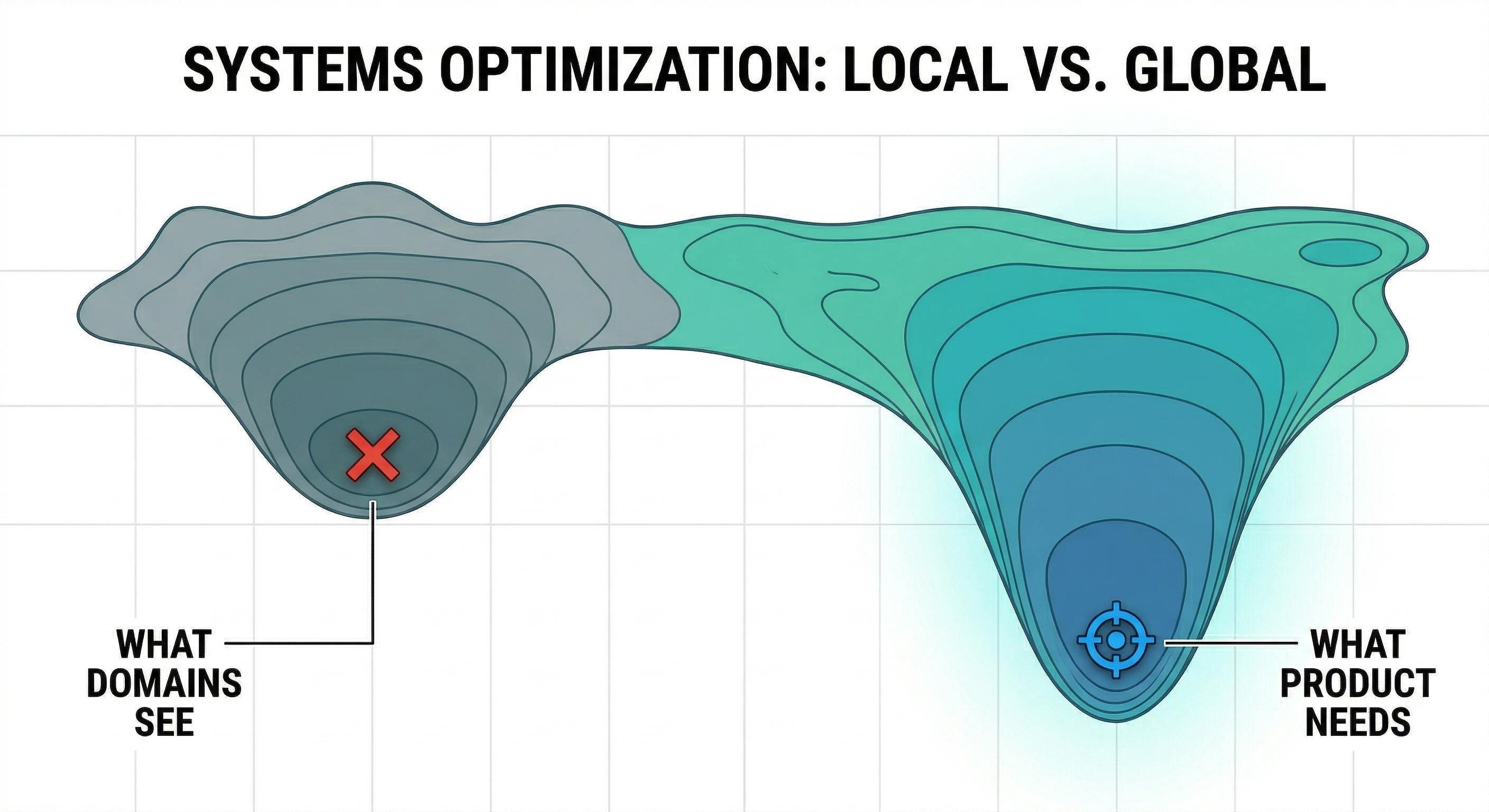
They operate on ruthless, flat accountability. They eradicate the role of the "middle-man" whose only job is to pass notes between silos. Instead, the mandate is simple: See it, solve it, iterate it.
If a software component requires a fundamental change to accommodate a physical hardware reality, that change is absorbed wherever it requires the least amount of time and friction. It might be absorbed at the conceptual layer, in the middle of the stack, or hacked into the final implementation.
In a traditional waterfall system, this triggers a turf war over who pays the "cost" of the change. In a modern, adaptable system, the only question that matters is: What is the fastest way to get this working so we can test it?
The Cost of Adaptability
Why do organizations still cling to domain fragmentations? Usually, it's a desire for executive legibility. Silos allow management to look at a crisp, one-page status report and feel like they are in control. But that control is a phantom, bought at the cost of massive bureaucratic drag.
Moving to an adaptable, systems-first approach removes that drag, but it is not a plug-and-play methodology. It requires a harsh environment to survive:
- Small, dense teams that cannot hide behind processes.
- Rigorous, painful iterations that force hardware and software to collide early.
- A high talent density, because this model demands engineers who are smart enough to understand the whole system and humble enough to compromise their own work for it.
This model is fragile. A single team deciding to hoard information and act as a silo can stall the entire machine.
But when a room is fully committed to the global minimum? You strip away the drag. You stop debating boundaries. You hit the dartboard.
- Kartikeya